


















The Slavic names of municipalities and villages in Kosovo are often problematic for Albanians, but recent initiatives to change them say more about an inferiority complex and the troubled times in which we live
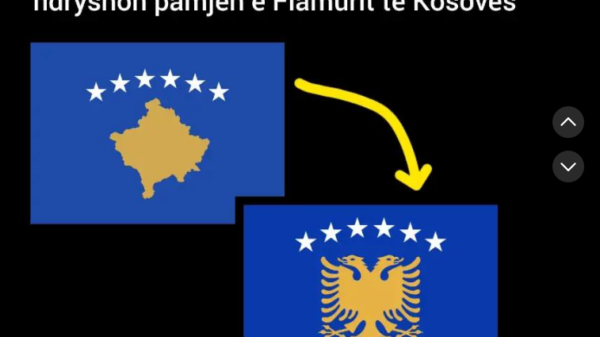
Last month, an initiative was launched in Ferizaj to change the Serbian-language name of the city, while another petition was launched this week to rename the Republic of Kosovo. Implementing these initiatives is practically impossible, and their emergence reflects an inferiority complex and the troubled times in which we live.
Slavic place names have troubled us from time to time, even creating awkward situations with names that sound unpleasant or vulgar in Albanian, such as Muçibaba (When “ç” is pronounced as “q” and the syllables separated, it translates to “my father got fuc*ked”). However, officially changing the names of places is currently unfeasible, and the discussion, in the way it has begun, approaches the problem from the wrong end.
The Practical Impossibility
Changing the official name of a municipality or village requires amending the Law on the Administrative Boundaries of Municipalities, while taking the next major step—changing Kosovo’s name—requires amending the Constitution. The Constitution can be amended only with the votes of two-thirds of all members of parliament. Amending a law defined by the Constitution as being of vital interest, such as the Law on the Administrative Boundaries of Municipalities, requires a majority of the votes of the members present and voting, including a majority of the votes of members holding guaranteed seats for non-majority communities.
Currently, the Parliament is in a deadlock, there is no new government formed yet, and there is no political will for this. Even if a government were formed and the initiative moved forward, the parliamentary majority would have to secure the Serbian List’s support for the adoption of the new names. The Serbian List could make its support conditional on renaming Zubin Potok “Nikola Pašić” and Leposaviq “Milan Radoičić”—the names of figures notorious among the Albanian majority. I would not be surprised if the Serbian List made such proposals, because the state that controls it has left similar names behind in Kosovo in the past.
Ferizaj and Hani i Elezit
The residents of Ferizaj do not encounter the name “Uroševac” in their everyday lives, while the reference to the name “Uroš” itself does not appear as aggressive as some other names. The paradox is that the request is coming from Albanians in a municipality where there are no Serbs, apart from the priest of the church located in the city center, which is known for sharing a courtyard with the mosque. Under normal circumstances, the debate on changing Ferizaj’s name in Serbian should be led by those who speak the Serbian language every day. In the current context, however, villages where Serbs lived before the war, such as Varosh, are empty, as they fled after the war ended.
I have seen the argument that changing place names was an instrument of colonial rule and of erasing Albanian identity in Kosovo. This argument is valid, but it is not sufficient to justify changing Ferizaj’s Serbian-language name. Let us not forget that Serbian historiography also recognizes a ruler known as Uroš the Weak, under whose leadership the political entity he had inherited from his father, Stefan Dušan, disintegrated in the 14th century.
The petition’s initiators have not sufficiently explained why it is necessary to erase the old name, why public resources should be spent for this purpose, or why members of parliament should commit themselves to changing Ferizaj’s name in a language that is “no longer in use” in the municipality.
What, then, should Albania do with Velipojë—from the Slavic Veliko Polje, meaning “large field”—and Berat—from Bel Grad, meaning “white city”? And what should Serbia do with Arbanas, Kastrat and Muzaće, places from which it expelled Albanians during the years when it was establishing its state? When the issue is approached in this way, it becomes clear that the starting point is an idea of cleansing. Yes, cleansing the traces of a people who once lived in a particular place or of an occupier who once ruled there.
Nevertheless, some names should be changed because of what they represent. The most problematic Serbian-language name is “General Janković,” which is the Serbian name for Hani i Elezit. The name General Janković is one of the absurdities enshrined in the Law on the Administrative Boundaries of Municipalities. This law is part of the Ahtisaari Plan, which largely defined the architecture of the Kosovo as a country.
Božidar Janković led the Serbian army in 1913 and committed massacres against Albanians in many places. At the time, the Bishop of Skopje, Lazër Mjeda, wrote that the Serbian army carried out massacres in Tetovo, Skopje, Kumanovo, Presheva, Gjilan, Ferizaj, Prizren, Gjakova and Peja, as well as in 27 villages in the Luma region of northern Albania. This is why I argue that the problem is being approached from the wrong end: the name General Janković is problematic, whereas the names Ferizaj and Kosovo are not.
The name “Gllogoc” should also be changed in official documents. In Albanian, everyone calls it Drenas. There are other settlements as well, such as the village of Bardhosh, which appears in official documents under the name Nëntë Jugoviqët, meaning Nine Jugović Brothers. This is a reference to the Kosovo myth about the nine Jugović brothers and their father, Jug Bogdan. The reference to the Kosovo myth is problematic because it is regularly used by the Serbian Orthodox Church to tell Serbs that they have to fight for Kosovo, that they will be cursed if they do not try to make it part of Serbia, and to oppose efforts to build peace in the region.
Inferiority complex
The line should be drawn when our own skin—the name of our country—is called into question. Kosovo may have a Slavic name, but that does not mean the country’s name should be changed. We do not need to shed our skin simply because Kosovo happens to be a Slavic-derived name. By doing so, we are not proving that we love Kosovo more; unfortunately, we are revealing an inferiority complex. Reading what the petition’s initiators have written to justify changing Kosovo’s name to Dardania, one might think that they are very proud of their identity. Yet a superiority complex is merely the other side of the inferiority-complex coin. The crux lies in the idea itself. And in effect, the initiative seeks to abandon the name Kosovo and surrender it.
We need to rid ourselves of this complex, and there are examples from which we can learn. There have been cases around the world in which the negative meaning of certain words has been overturned by the very people stigmatized by them. Take the word “queer.” Its original dictionary meaning in English was used to describe people considered “strange.” Nevertheless, LGBT+ communities in many countries decided to reclaim it. They adopted it as a term for themselves, to the extent that, in many contexts, “queer” is now used in place of LGBT+ and no longer refers to someone who is strange. In this sense, even if the name Kosovo is Slavic in origin, we have no reason to regard it as a debt owed to Serbia or to Serbs. “I have no land to divide…” as the poet Ali Podrimja once said.
The Serbian state-run outlet Kosovo Online has covered the initiative to change Kosovo’s name, not only by republishing reports from other media outlets but also by conducting interviews. In its interviews with people in Kosovo and Serbia, it has addressed topics ranging from the Dardanians and the question of whom Kosovo belongs to, and whether the initiative to rename Kosovo is appropriate. The Serbian outlet appears to enjoy every statement or speech that challenges the present-day identity of Kosovo Albanians and their identification with the state.
The name “Kosovo” may be Slavic in origin, but this should neither make us shed our skin nor love our country any less. Other place names may also be Slavic, but they do not threaten the identity of Kosovo Albanians. Slavic place names show that Serbia has had a presence in Kosovo, but this is where the line must be drawn: they do not undo the everyday reality of Kosovo as an independent state.
Reconsideration
Naming settlements has been part of violence, dispossession, and Serbianization, as well as the destruction of indigenous culture. Occupiers steal, bring in settlers to rule, and change names without consulting the people they have occupied. Reconsidering these names can also be an authentic attempt to reimagine what the occupier erased and restore what originates from us.
Conceptually, some names are worth changing: “Glogovac” and “Nëntë Jugoviqët” should not appear in Albanian-language documents when the names Drenas and Bardhosh are used in practice. And, of course, the name “General Janković” should be removed from official usage and preserved in the archives as evidence of Serbia’s colonial legacy.
But the line must be drawn where the idea turns into an attempt to “cleanse” names. In practice, renaming should be carried out carefully, while such discussions should be opened to the public when they serve practical needs. They should be approached carefully.
Bad Times
Behind this debate lies another dimension: society and the state are trapped in an endless crisis, with unemployed young people who do not even appear in the statistics as jobseekers, most women remaining outside the labor market, persistent underdevelopment, and a Constitution that is violated every day because the constitutive session of the Assembly is not convened every 48 hours. The troubled times in which we live provide fertile ground for demands such as changing Ferizaj’s Serbian-language name or renaming Kosovo altogether.
Kosovo is going through a crisis whose consequences can be felt everywhere, and we are failing to hold political parties to account for the irresponsibility they demonstrate every day. This situation manifests itself as fatigue among some people and frustration among others. Under these circumstances, all kinds of debates emerge, while frustration is directed at the wrong targets.
Slavic place names may evoke a violent past for Kosovar Albanians. They may bring back dark memories, but they should not serve as grounds for feeling either indebted to the former occupier or inferior. These place names are not the problem threatening Kosovo. The threats that truly endanger Kosovo are irresponsible governance, unemployment, gender inequality, stalled development, and Serbia.
Translated by AI and reviewed by an editor.
Author