















How Performance Is Replacing Argument in Television Debates
Kosovo probably has more hours of political debate per capita than most countries in the region. Nevertheless, this has not made debates high quality; but merely exposed the public to an enormous volume of opinions. As a result, the public’s ability to distinguish arguments from media performance has been severely weakened.
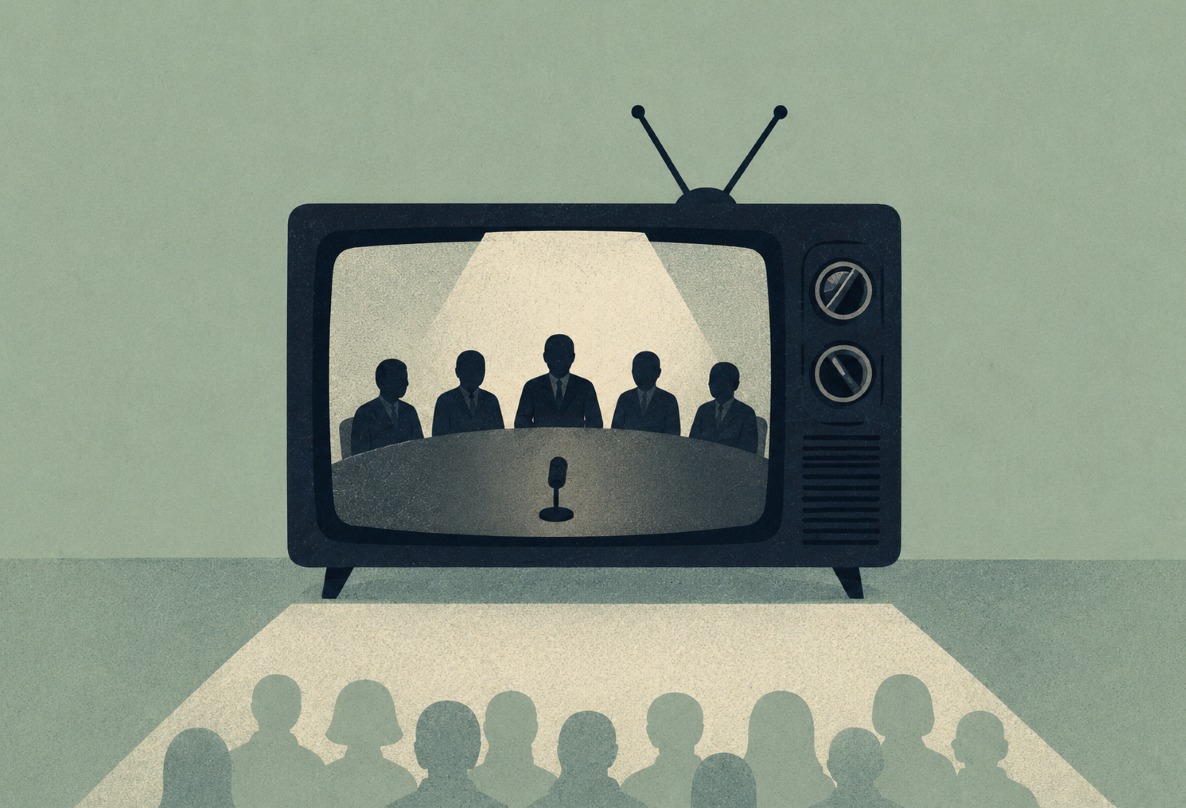
TV debates, as a primary instrument of democracy, have been transformed into a mechanism for generating public noise.
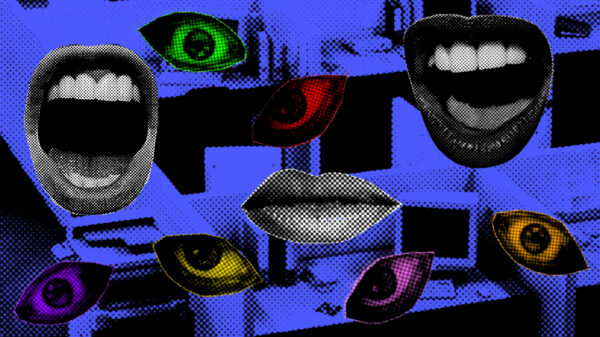
Kosovo’s public sphere has long been experiencing a crisis of debate. In television studios, it is the loudest voice, the quickest interruption and the most theatrical gesture that attracts attention, while the argument itself takes a back seat.
Society needs continuous and reasoned debate, not a cacophony of opinions that torments the public without helping it understand reality more clearly. There are few television debates in which one can hear arguments, structured opinions or ideas concerning specific issues. “You are lying,” “ignorant,” “criminal,” “thief,” “clueless,” and similar expressions have begun to be treated as normal in television debate programmes. The problem lies not only in the use of insulting language, but also in the shift from a confrontation of ideas or opinions to an attack on the interlocutor.
This discursive violence is intended not only to challenge an idea, but also to dominate, humiliate, silence or exclude the other person. When debate does not serve to confront arguments but to impose opinions by shouting, it loses its fundamental function, calling deliberative debate into question. Can our society truly process this enormous volume of debate taking place at almost every hour of the day and every night?
The problem is not only the way debate is conducted, but also its volume, which often turns public discussion into an uninterrupted stream of opinions.
At a quarter past eight in the morning, one of Kosovo’s television channels was passionately discussing the election of the president. That afternoon, another channel was debating whether a government could be formed, while in the evening a third channel was discussing the crisis one of the political parties is facing. In all these debates, there was noise and a struggle for dominance, set against a backdrop of spectacle. It is precisely this shift from argument to spectacle that goes against the fundamental idea of rational public debate.
The German philosopher Jürgen Habermas conceives of the public sphere as a space in which citizens debate matters of common concern through rational argument. According to Habermas, debate should be governed by the non-violent force of the better argument. We have witnessed how Habermas’s proposition has long been overturned in Kosovo’s television debates, allowing the power of the voice and the ability to create spectacle to prevail. The large number of panellists, frequent interruptions and moderation deliberately designed to produce viral moments have normalised aggression in television studios. Proliferation of television debates exceeds the public’s capacity to consume them.
The problem is further compounded by the fact that these debate programmes now routinely feature people who attempt to package their opinions as expertise.
Even in the field of political analysis, we frequently see people assuming the role of analyst without possessing the experience, specialization or knowledge required to address the topics under discussion.
In the past, more professional filters existed before someone could appear in the media as a public voice. Today, people with professional experience in one field—such as an imam, priest, singer, hairdresser, lawyer, footballer, coach or dressmaker—frequently present themselves as authorities on matters entirely beyond their competence, ranging from sport and family relations to healthcare and social issues.
Participation in public debate is a natural part of democracy. Responsibility, however, lies with the media, which must distinguish between personal experience, opinion and professional expertise. Guests may speak about their personal experiences, but they should not assume the role of experts.
Through this approach, the epistemic boundary between what we know and what we think is gradually being blurred.
Today, it seems that having an opinion on every subject has become a kind of public obligation. Në hapësirën mediatike kjo shfaqet kur siguria në të folur shpesh ngatërrohet me kompetencën, ndërsa opinioni personal paraqitet si analizë e specializuar. A psychological dimension of this phenomenon can be explained through the Dunning–Kruger effect, according to which individuals with limited knowledge in a particular field may overestimate their ability to understand and explain it. In the media, this becomes evident when speaking confidently is mistaken for competence, while personal opinion is presented as specialised analysis.
Every night on television, the topics change, but the people offering their opinions do not. This practice has turned debate into an oligarchy of opinion, in which a small number of figures monopolise the interpretation of public reality. Consequently, the public hears the same voices all the time, while experts remain outside the spotlight.
In this way, the phenomenon of the universal analyst has gradually produced a crisis in the authority of knowledge.
Tom Nichols addresses this crisis in his book The Death of Expertise (2017). Modern societies, according to him, do not merely distrust experts, but their problem is the erosion of the idea that specialised knowledge should carry greater weight than ordinary opinion. The death of expertise, according to Nichols, is not the rejection of expertise itself, but the rejection of the idea that expertise matters.
What does expertise matter when the public is capsized by rhetoric? Kosovo’s culture of public communication continues to reflect an approach based not on the substance of arguments, but domination of confrontation. In conversations following debate programmes, instead of asking, “What argument did they make?”, the central exchange is often: “Did you hear that?” “Yes, but what did they say?” “I don’t know, but he really knocked him out..” This common response shows that the public often measures the success of a debate not by the strength of the argument, but by the ability to defeat the opponent.
When everyone speaks and no one understands anything, the argument is the loser.The more clearly we distinguish between opinion, personal experience and verified knowledge, the higher the quality of debate will be. The media bear significant responsibility in this regard. Television channels should not give equal weight to every opinion, but must exercise editorial responsibility over those they legitimise as public authorities. The television screen is not a laboratory for experimenting with random opinions, but a space in which the public expects argumentation, context, verification, and competence.
Debate is never measured by the number of people taking part, but by the quality of the arguments it produces. As Karl Popper argues, we do not move closer to the truth by claiming to possess it, but through criticism and the continuous correction of errors.
Translated by AI and reviewed by an editor.