
Western Balkans’ Race for Better Living Standards in 2025: Who Is Catching Up with the EU?
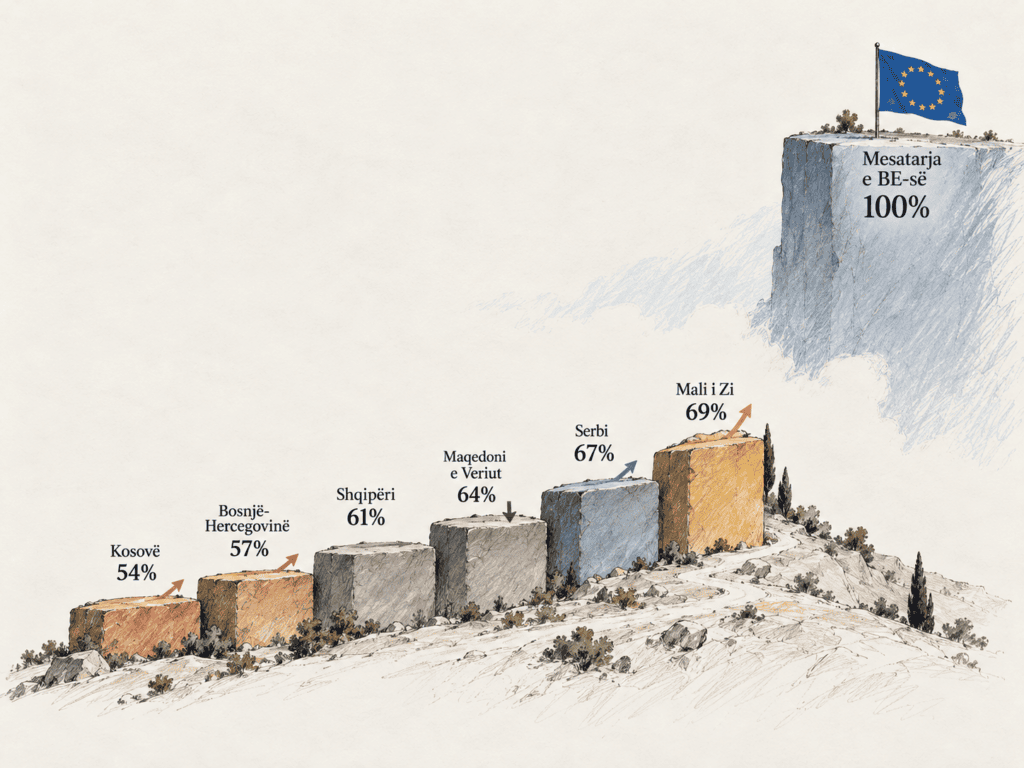


Western Balkan countries continue to face a significant gap in well-being compared with the European Union, while progress towards European standards varies across the region.
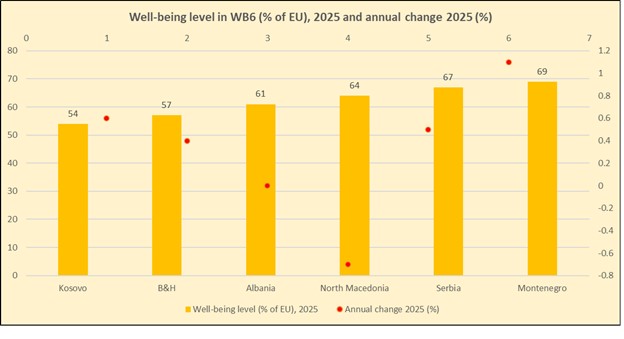
Updated 2025 data from the Vienna Institute for International Economic Studies (wiiw) show that Montenegro leads the six Western Balkan economies, with a well-being level equivalent to 69% of the EU average, followed by Serbia at 67% and North Macedonia at 64%. Albania ranks fourth, at 61% of the EU average, while Bosnia and Herzegovina stands at 57% and Kosovo at 54%.
These differences show that, despite their shared European integration aspirations, Western Balkan countries have different levels of development and face distinct challenges in converging with EU standards.
Montenegro, which leads the region, recorded the strongest improvement in convergence in 2025, narrowing the gap with the EU average by 1.1 percentage points. Kosovo improved its relative position by 0.6 percentage points, Serbia by 0.5 percentage points and Bosnia and Herzegovina by 0.4 percentage points.
Meanwhile, Albania recorded no change in its overall well-being indicator, remaining at 61% of the EU average. North Macedonia registered a slight deterioration. Although most countries in the region made some progress towards closing the gap, improvements were uneven and too limited to significantly change their standing relative to the EU.
Well-being convergence is a broader process than economic growth alone. It encompasses income, living conditions, the quality of public services, education, healthcare, infrastructure, governance, the environment and digitalisation. Progress in any single area is therefore insufficient to ensure overall convergence with European standards.
For Western Balkan countries, the challenge is to translate economic growth into sustained improvements in well-being and a narrowing of the gap with EU citizens. The 2025 figures show that this process remains slow, with substantial disparities both among the countries of the region and between the Western Balkans and the EU.
The prospect of EU membership continues to provide an incentive for reforms, but well-being indicators demonstrate that progress towards European integration must be accompanied by tangible improvements in economic performance and quality of life. Even where progress is being made, its pace remains too slow to substantially narrow the gap with European standards./ B.Hoxha
Source: wiiw
Ky është artikull ekskluziv i Revistës Monitor, që gëzon të drejtën e autorësisë sipas Ligjit Nr. 35/2016, “Për të drejtat e autorit dhe të drejtat e lidhura me to”.
Artikulli mund të ripublikohet nga mediat e tjera vetëm duke cituar “Revista Monitor” shoqëruar me linkun e artikullit origjinal.