
Albania’s Economy Grows on Construction, Trade and… Heavy State Support
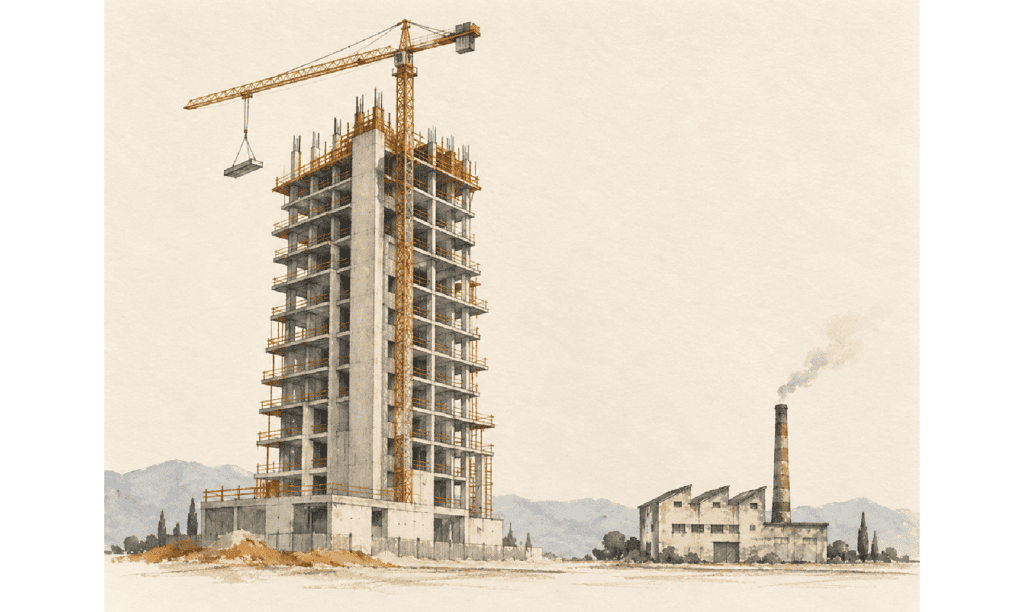


Albania’s economy grew by 3.66% in 2025, but the expansion was driven largely by substantial state support through public-sector wages, construction, real estate and tourism-related services. Construction has maintained an unusually large share of the economic structure for years, accounting for 12.6% of GDP, the highest level in the region and above the European average. At the same time, industry has entered a deep recession. The ranking of the largest companies by revenue reflects the same pattern, with trade, energy, fuel and construction dominating, while the challenge for a country experiencing a continued population decline is to shift toward an economy that generates greater added value and employment
Ornela Liperi
Albania’s economy continued to expand in 2025, but the structure of this growth points to a reliance on sectors that generate high turnover without creating productive capacity to the same extent.
Gross domestic product reached ALL 26.5 trillion, or around €27 billion, while the economy grew by 3.66%, the lowest growth rate since the post-pandemic recovery period, according to data published by INSTAT.
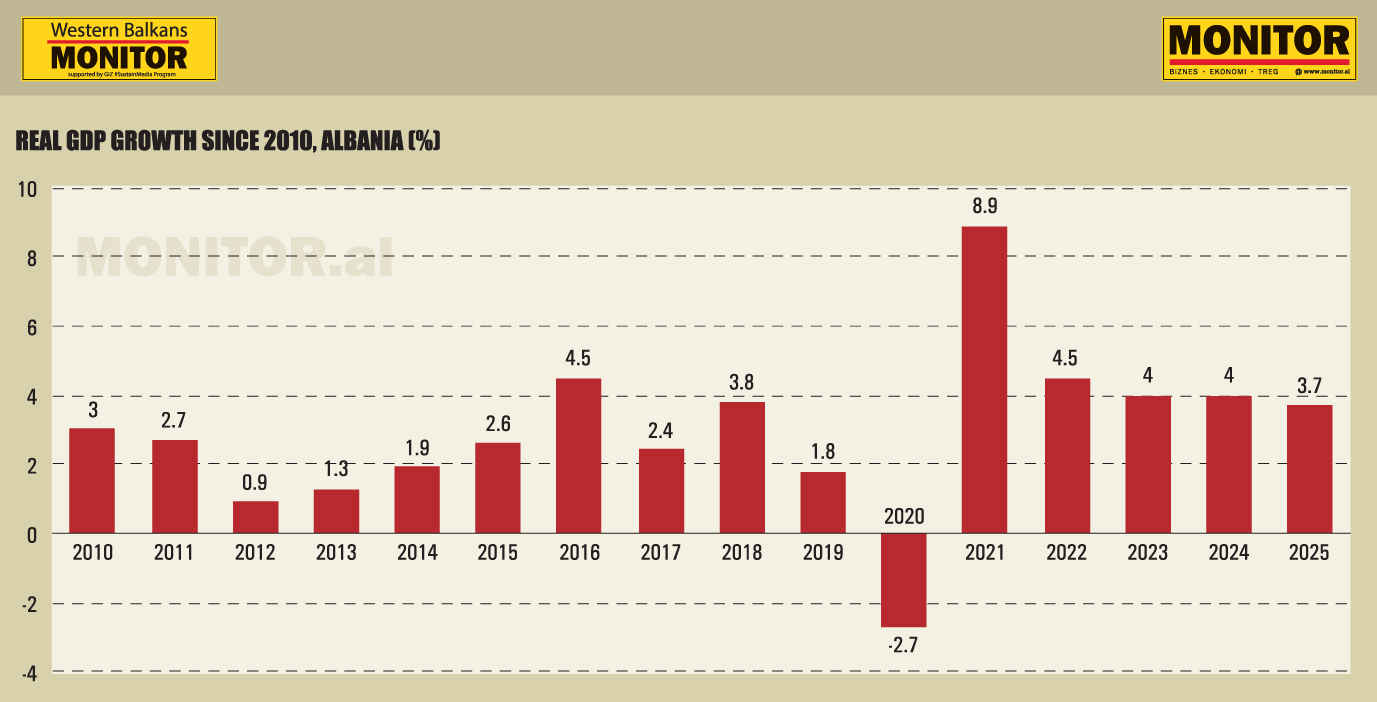
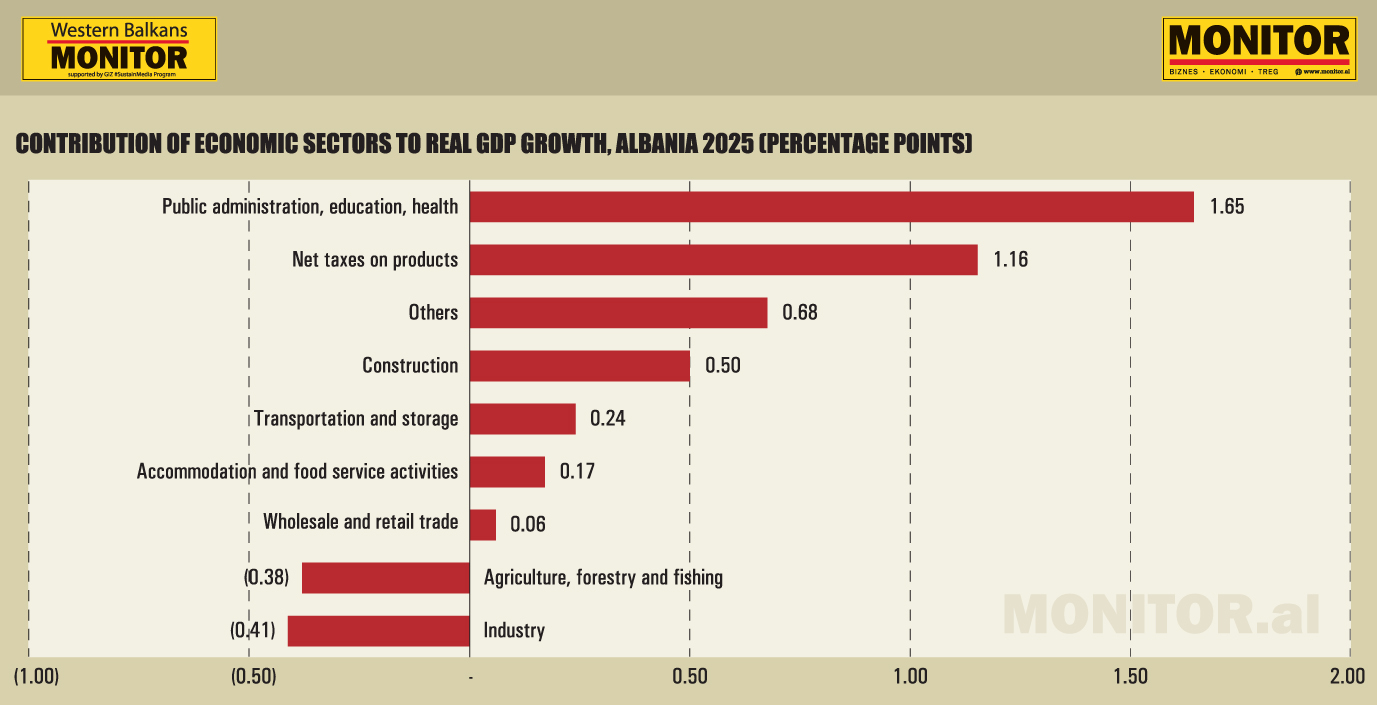
For the second consecutive year, a significant share of growth came from public administration and net taxes, driven mainly by higher public-sector wages. Excluding these two activities, the expansion of the private economy in 2025 was only 0.86%.
In the real economy sectors, growth was concentrated in a few activities. Construction contributed around 0.5 percentage points, real estate 0.42 percentage points, while trade, transport, accommodation and food services contributed 0.47 percentage points. On the other hand, industry and agriculture made negative contributions of -0.5 and -0.38 percentage points, respectively.
Construction, the highest share in the region and Europe
Construction has become one of the main pillars of the Albanian economy. The increase in housing investment, tourism developments and infrastructure projects has expanded activity in the sector, but at the same time has increased the economy’s dependence on it.
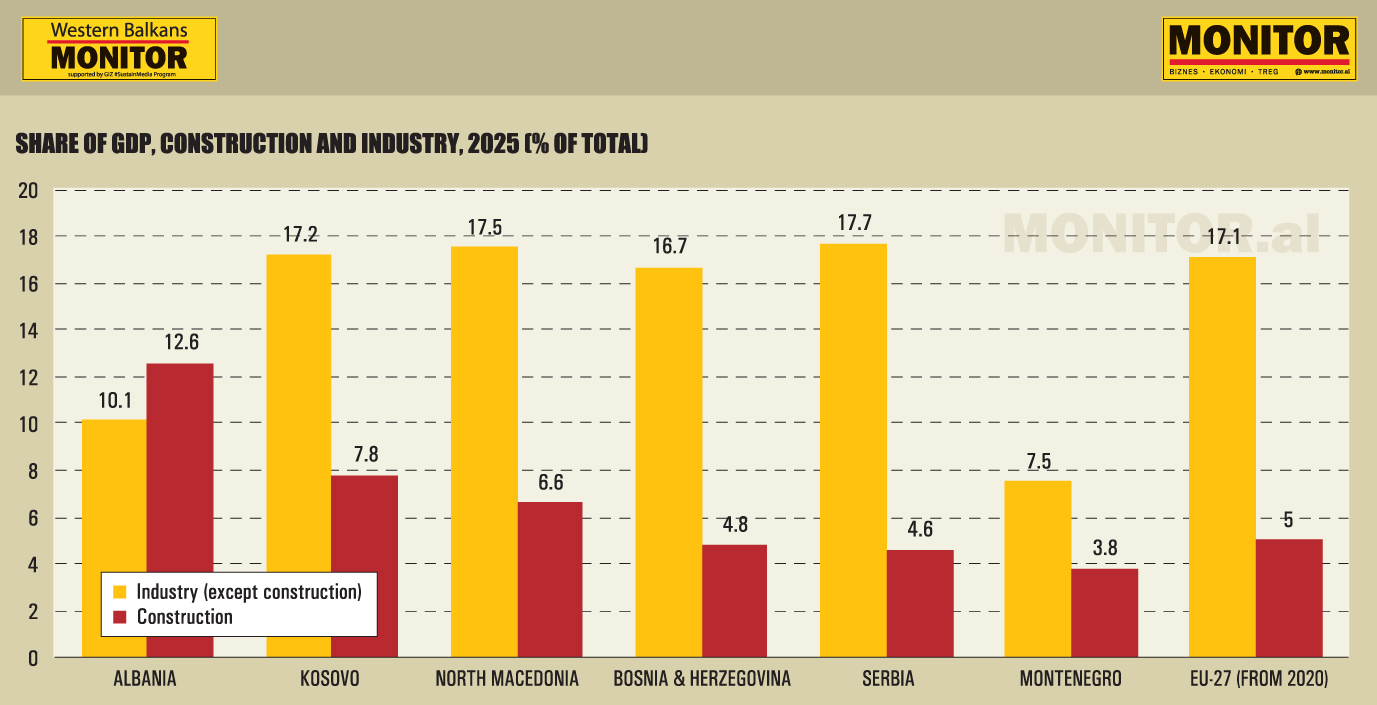
In Albania, construction accounts for 12.6% of GDP, the highest share not only in the Western Balkans but also compared with the European average. In other countries in the region, the sector’s share is significantly lower: Kosovo 7.8%, North Macedonia 6.6%, Bosnia and Herzegovina 4.8%, Serbia 4.6% and Montenegro 3.8%, while the European average is around 5%.
Over the past three years, the sector has expanded faster than the rest of the economy, increasing its value added from around ALL 260 billion in 2023 to around ALL 290 billion in 2025, or by approximately 11%. Over the same period, manufacturing moved in the opposite direction, declining from around ALL 216 billion in 2023 to around ALL 214 billion in 2025, a decrease of 1.1%. The gap between the two sectors points to a gradual shift in the Albanian economy away from productive activities and toward construction and services.
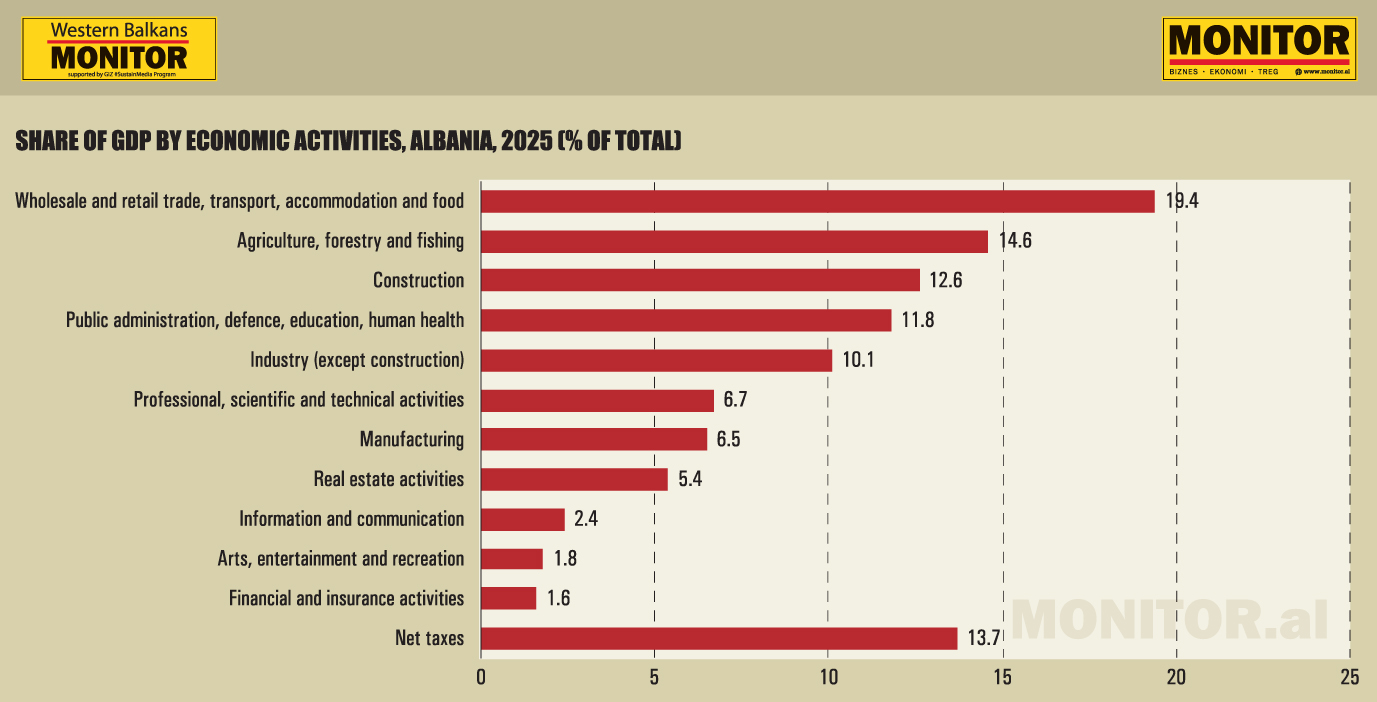
The growth of construction has provided a strong economic boost, but the model has its limitations. The sector is closely linked to the investment cycle, housing demand and developments in the real estate market. One element raising concerns about the sustainability of this model is the way the sector is financed. Analysis of construction companies’ balance sheets shows that their expansion has relied not primarily on bank lending, but on customer advances and liabilities to suppliers. For a sample of 163 construction companies, customer receivables accounted for around 29% of assets, liabilities to suppliers around 20%, while bank debt accounted for only around 5% of assets.
This financing model makes the sector more dependent on continued sales and the pace of collections. If demand for property slows or the sales cycle becomes longer, pressure could spill over into companies’ liquidity and the supplier chain. For this reason, the high concentration of investment in real estate is seen as a potential source of vulnerability for the economy, particularly in a market where part of project financing passes outside traditional banking channels, which, according to investigations by SPAK, has served as a channel for the infiltration of informal money into the economy.
According to Sokol Kraja, an economist and entrepreneur, construction has supported the economy, but capital should be directed toward sectors with higher added value.
“Construction is a temporary development. Once its cycle is completed, we hope that the concentration of capital will shift toward investments with high added value, in industry, electronic startups and software, which would significantly support the Albanian economy and employment,” Mr. Kraja said.
Industry loses ground as the economy moves away from its productive base
In contrast to construction, industry is going through a prolonged period of weakness. The sector has entered a downward cycle, while manufacturing has been contracting for nine consecutive quarters, since the end of 2023 – the longest period of decline for the sector since the 1990s.
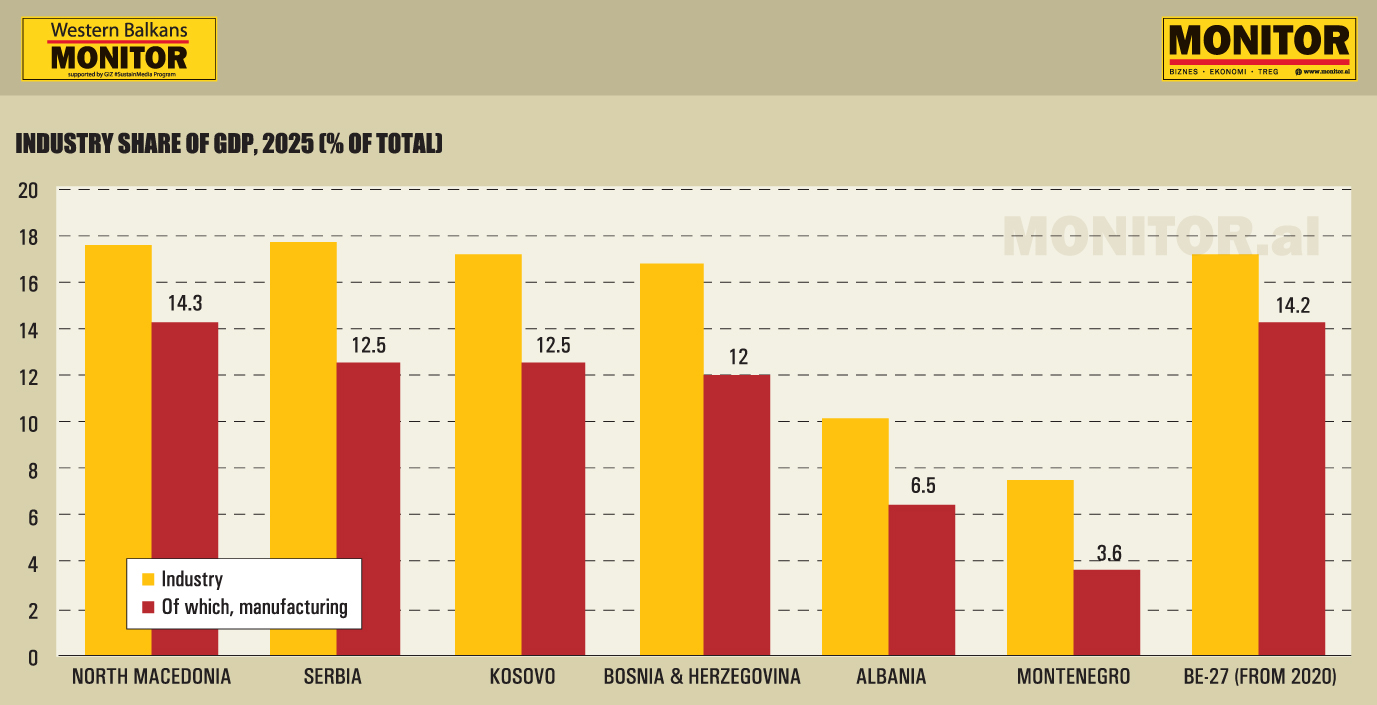
The weakening of industry has also reduced its share in the country’s economic structure. Industry as a whole accounts for around 10.1% of GDP, with the largest share coming from manufacturing at 6.46%, followed by electricity at 2.15%, extractive industries at 0.94%, and water supply and waste treatment at around 0.52%. This is significantly lower than in some regional economies, where manufacturing accounts for 14.3% of GDP in North Macedonia, 12.5% in Serbia and around 12% in Bosnia and Herzegovina.
The decline in industry is most evident in sectors that for years have been the backbone of Albanian exports. Textiles, clothing and footwear, which have been among the largest employers in the private sector, are facing a difficult period due to rising costs, labor shortages and the gradual loss of the low-cost labor advantage. Manufacturing alone employed around 95,000 people in 2024, or about 17% of employment generated by businesses, making it one of the largest employers in the economy, according to INSTAT.
The problem facing Albanian industry is not only declining production, but also the model on which part of the sector has been built. A large share of traditional exports relies on processing under the buyer’s materials model, in which Albanian companies have less room to influence prices and absorb rising costs. The depreciation of the euro, rising wages and labor shortages have further squeezed the margins of these businesses.
Florjan Zekja, from the Manufacturing Association, stresses that the main challenge for Albanian industry is the transition from a model based on low-cost labor to one driven by greater technology, productivity and added value. According to him, closer integration with the European Union will bring greater market opportunities, but also stronger competition for companies that fail to improve efficiency and production standards.
The weakening of industry comes at a time when integration into the European market requires a stronger productive base. Joining EU supply chains is not only about lower costs, but also about the ability to produce more complex products, invest in technology and build long-term export capacity.
The Largest Companies, a Reflection of the Economic Model
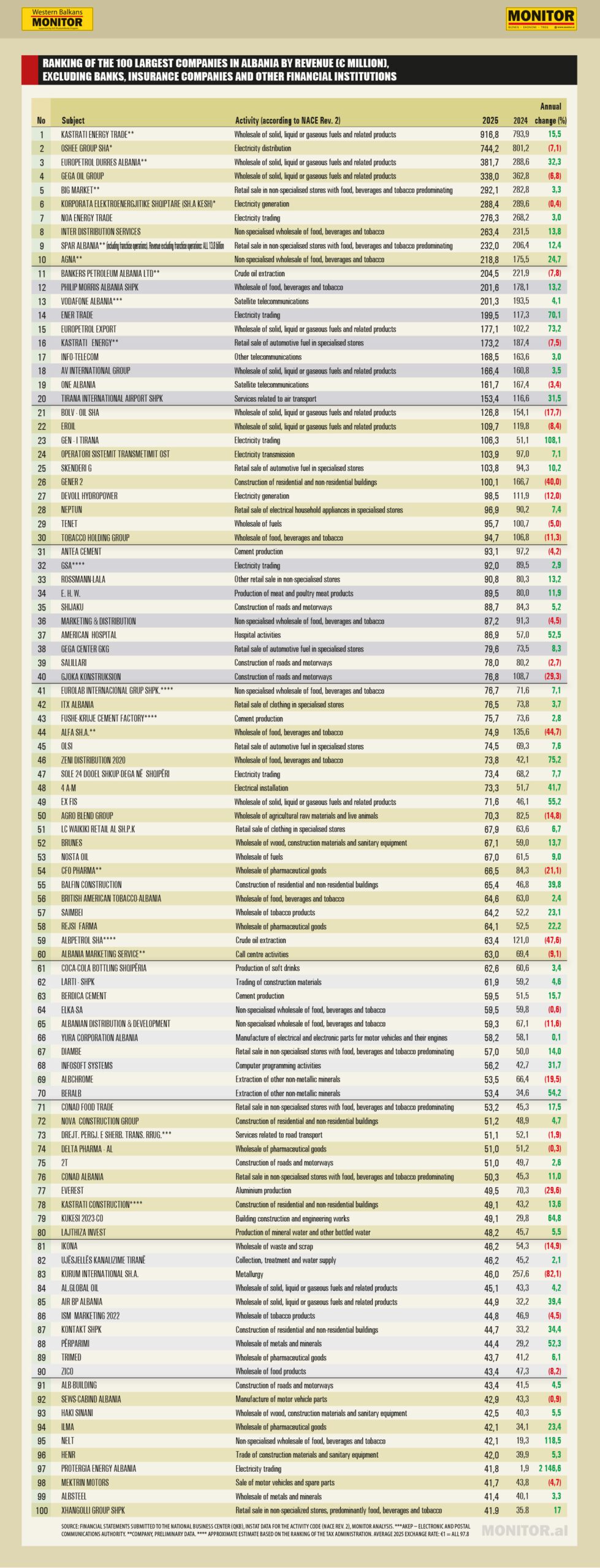
The structure of the largest companies by revenue is another indicator of this model. At the top of the Albanian economy are trading companies, distributors, fuel and energy traders, and construction companies.
In 2025, the 200 largest companies in the country generated around ALL 1.47 trillion in revenue, or approximately €15 billion. Their performance was driven mainly by sectors such as oil trading, energy and construction – activities that are heavily dependent on international prices, imports and the pace of new projects.
However, high turnover does not automatically translate into added value or employment. Around 40% of the largest companies have personnel expenses accounting for less than 5% of their revenue. In many cases, these are trading and distribution companies that handle large volumes of goods but require relatively few employees.
A low ratio of personnel costs would be a positive indicator if it resulted from automation or technology. But the structure of these companies shows that it is mainly linked to the nature of trading activities, where value is created more through sales volume than through production processes.
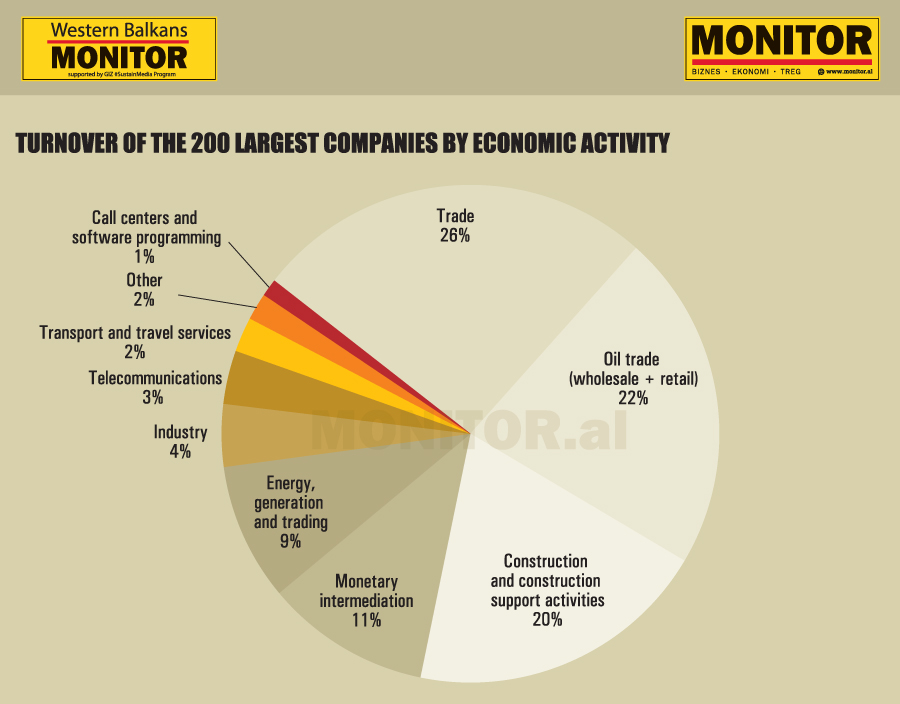
The data processed by Monitor show that 48% of the turnover of the country’s 200 largest companies comes from trade and hydrocarbon trading alone, while construction and related activities account for another 20%. The concentration of turnover in these activities highlights the significant share of trade, distribution and intermediation among the largest companies, while manufacturing accounts for just 4% of total turnover.
Labor Shortages Are Becoming a Permanent Economic Challenge
Demographic changes are becoming a long-term economic challenge. The INSTAT census recorded around 420,000 fewer people compared with 2011, while the population at the beginning of 2026 fell to around 2.33 million.
The labor shortage is affecting business expansion. To meet their needs, companies are increasing the employment of foreign workers, whose number reached around 22,000 in June 2026.
Against this backdrop, Albanian businesses need to adapt not only by finding new sources of labor, but also by increasing productivity and competitiveness, particularly as closer integration with the European Union requires compliance with higher standards.
A shift toward industry, technology, exports and higher-productivity sectors is becoming essential to address the effects of emigration and competition in the European market. The shrinking working-age population is limiting business expansion, while integration into the European single market will increase demands for higher product standards, technology and efficiency.
Without a transformation of the productive base, the economy risks remaining dependent on more cyclical and lower-productivity sectors, making it more difficult to raise wages, retain workers and compete in EU markets.
Top 10 Companies in Albania by Revenue (excluding banks)
The 10 largest companies (excluding banks) generated nearly €4 billion in annual revenue, equivalent to around 14.5% of GDP. Three of the companies operate in the wholesale fuel trading sector.
These companies employed around 13,000 people, but approximately 60% of them work for two state-owned electricity distribution and generation companies.
- “Kastrati Energy Trade”
The country’s largest importer and wholesaler of oil, “Kastrati Energy Trade” was Albania’s largest company by revenue in 2025. The company reported €916 million in revenue in 2025, up 15.5% year on year. The company is part of “Kastrati Group”, the country’s largest business group, with interests also in construction, hospitality, insurance, ports and the concession-based management of Tirana International Airport.
- “OSHEE Group”
The Electricity Distribution Operator (“OSHEE Group”), a state-owned company, owns three companies: the Universal Service Supplier, the Free Market Supplier and the Distribution System Operator (OSSH). According to official data from the Ministry of Finance’s actual budget, the combined annual revenue of the three companies, after netting out intra-group revenues, amounted to €744 million in 2025, down 7.1% year on year, making it the country’s second-largest company by revenue and the largest state-owned enterprise.
- “Europetrol Durrës Albania”
“Europetrol Durrës Albania”, a wholesale fuel trading company, was the third-largest company in the country by revenue. The company reported strong growth of 32.3%, with annual revenue reaching €380 million.
- “Gega Oil Group”
“Gega Oil Group” ranked as the fourth-largest operator in the country in 2025 and the third-largest wholesale fuel trading company. The company reported annual revenue of around €338 million, down 6.8% year on year.
- “Big Market”
“Big Market”, the country’s largest supermarket chain, ranked fifth based on consolidated annual revenue across its entire network. According to official data, the company’s revenue was around €292 million, up 3.3% compared with the previous year.
- Albanian Power Corporation (KESH)
The Albanian Power Corporation (KESH), the state-owned electricity generation operator, ranked sixth. In 2025, revenue amounted to €288 million, almost unchanged from the previous year, according to data from the Ministry of Finance’s actual budget.
- “NOA Energy Trade”
“NOA Energy Trade”, which operates in electricity trading, reported €276 million in revenue, up 3% compared with the previous year. Electricity trading is an activity that has expanded in Albania in recent years following the gradual liberalization of the market and the entry of private companies that intermediate electricity purchase and sale transactions, particularly electricity sourced through imports.
- “Inter Distribution Services”
“Inter Distribution Service” is the country’s largest wholesale distributor of food products. Annual revenue reached €276 million, up 14% from the previous year, marking the second consecutive year of double-digit growth.
- “Spar Albania”
“Spar Albania” is Albania’s second-largest supermarket chain. Including revenue from “Spar Franchise”, total annual revenue reached €232 million, up 12.4% year on year, according to official company data. This was the first year in which the “Spar Albania” supermarket network operated for part of the year as part of the Kosovo-based company “Viva Fresh”. In mid-2025, “Viva Fresh” acquired the supermarket chain from BALFIN Group for €36.4 million, according to the transaction registered with the National Business Center.
- “Agna”
“Agna”, the country’s second-largest distribution company, recorded annual revenue of €218 million, up 25% year on year, according to preliminary company data (the official financial statements have not yet been published). As a group, “Agna Group”, together with its other company, “Alfa”, is the country’s largest distributor. The two companies together generated €293 million in revenue, down 5.6% compared with 2024.
North Macedonia vs Albania: Job Creation Versus Revenue Generation
The ranking of the largest companies broadly reflects the economic structure of each country.
In North Macedonia, for example, where manufacturing is more developed, three of the country’s ten largest companies operate in the automotive industry, reflecting the government’s policies to attract investment through free economic zones.
Johnson Matthey is North Macedonia’s largest company, with revenue of €1.82 billion, approximately twice that of Albania’s largest company, which operates in fuel trading, even though North Macedonia’s economy is nearly 40% smaller. The company employs 835 people and specializes in manufacturing automotive catalysts and emission control systems.
Kromberg & Schubert – Macedonia, the country’s seventh-largest company, generated €322 million in revenue. It manufactures electrical and electronic equipment for vehicles and is one of the country’s largest employers, with nearly 7,500 employees.
By comparison, Albania’s seventh-largest company (excluding banks) generated approximately €270 million in revenue but employed fewer than 10 people, as its main activity is electricity trading.
VDL Bus – Macedonia ranks tenth among North Macedonia’s largest companies, with revenue of €252 million. The company is involved in the production of automotive components and also operates within the country’s free economic zones.
North Macedonia’s Technological Industrial Development Zones (TIDZ) have been one of the country’s main instruments for attracting foreign direct investment, particularly in the automotive industry. This strategy has enabled North Macedonia to compete effectively with Albania for major investors, with many large companies choosing North Macedonia as their investment destination, attracted by a more skilled workforce and tax incentives.
Through tax relief, investment subsidies and support for exporters, these zones have helped increase exports, create jobs and integrate the country into European manufacturing supply chains.
However, the model has also attracted criticism. Some experts argue that investments in these zones have established only limited links with the domestic economy, as a significant share of production relies on imports and lower-cost labor, while the benefits in terms of technology transfer and the development of local suppliers have been more limited.
The International Monetary Fund (IMF) recommends shifting the investment policy model away from an approach based primarily on tax incentives for export-oriented foreign investment, towards one that strengthens competitiveness, links with domestic companies, productivity growth and deeper integration into European value chains.
North Macedonia
The 10 largest companies generated total revenue of €5.2 billion in 2025, equivalent to 31.3% of the country’s GDP. Together, these companies employed approximately 20,000 people, 42% of whom worked for three automotive industry companies operating in the Technological Industrial Development Zones.
Albania
The 10 largest companies (excluding banks) generated annual turnover of nearly €4 billion in 2025, equivalent to approximately 14.5% of GDP. These companies employed around 13,000 people, but approximately 60% of them worked for two state-owned electricity distribution and generation companies.
Albania vs Serbia: A Trade-Driven Economy Versus a Manufacturing-Based Model
The structure of the region’s largest companies reveals two distinct models of economic development. While Serbia benefits from a broader industrial and manufacturing base, Albania’s largest businesses are concentrated primarily in trade, energy and construction.
In Albania, trade dominates the revenue of the 100 largest companies, with 54 businesses generating €6.18 billion in 2025, accounting for 56.2% of the total. Electricity ranks second, with 10 companies generating 18.4% of total revenue. Construction and related activities, including cement manufacturers, are represented by 15 companies, with approximately €999 million in revenue, or 9.1% of the total. By contrast, manufacturing, excluding producers of construction materials, accounts for just seven companies, generating approximately €397 million, or 3.6% of total revenue, according to data published by Monitor.
The contrast with Serbia is striking. According to data published by the Serbian Business Registers Agency (APR), manufacturing accounts for 24.6% of the revenue generated by Serbia’s 100 largest companies, compared with just 3.6% in Albania. Meanwhile, trade represents 29% of the total in Serbia, against 56.2% in Albania, reflecting the stronger orientation of Albanian businesses towards trading rather than manufacturing.
The difference is equally significant when it comes to profits. In Serbia, profits are concentrated in mining and manufacturing, which together generated 54.3% of the combined net profit of the country’s 100 most profitable companies. Manufacturing alone accounted for 34 companies, with total profits of approximately €1 billion. The profitability of manufacturing companies gives them greater financial capacity to undertake new investments, expand production facilities and increase productivity.
Nevertheless, mining was the most profitable sector. Just five companies generated 34.7% of total profits, equivalent to €1.77 billion, largely driven by the two mining giants, Serbia Zijin Mining and Serbia Zijin Copper.
Information and communication accounted for 9.9% of profits, construction for 9.2%, energy for 9%, and wholesale and retail trade for just 7.4%.
In Albania, manufacturing and mining combined generated only 7.7% of the profits of the largest companies, compared with 54.3% in Serbia.
Instead, profits in Albania are concentrated mainly in energy (34%), trade (24.5%), and construction and related activities (18.2%), according to calculations by Monitor based on the ranking of the 100 largest companies, excluding financial institutions.
Click here to register for free and access the full edition of the ranking of the largest companies in the Balkans for 2025:
https://monitor.al/monitor-special-edition/
EXCLUSIVE: The VIPs of Western Balkan Business
50 biggest of North Macedonia; “Swimming” in turbulent economic “waters”
Serbia’s Top 100 by Revenue and Profit: Slow Growth Amid Political Uncertainty in 2025
Montenegro’s Top 100 Companies: Economic Growth Masks Structural Weaknesses
Bosnia and Herzegovina’s Largest Companies: Moderate Growth and Structural Challenges
Kosovo’s Top 10 Companies: Economic Growth Amid Institutional Crises and Challenges
Ky është artikull ekskluziv i Revistës Monitor, që gëzon të drejtën e autorësisë sipas Ligjit Nr. 35/2016, “Për të drejtat e autorit dhe të drejtat e lidhura me to”.
Artikulli mund të ripublikohet nga mediat e tjera vetëm duke cituar “Revista Monitor” shoqëruar me linkun e artikullit origjinal.